
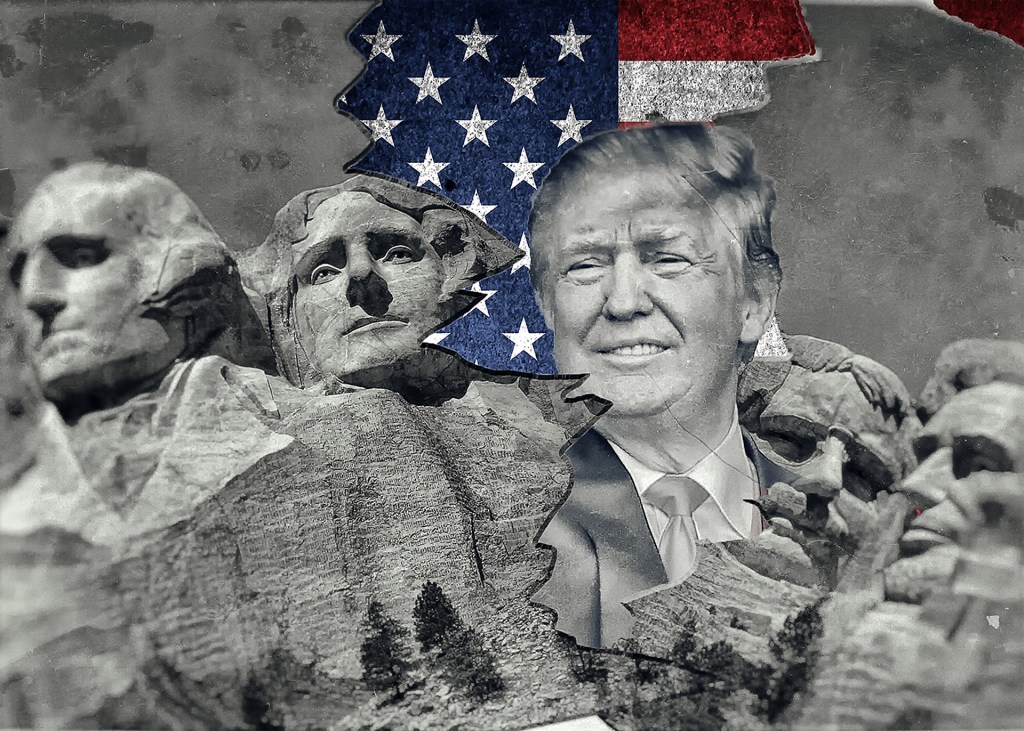
During the 2016 United States presidential election, political outsider and successful businessman Donald Trump revolutionized the electoral landscape by employing an unorthodox campaign strategy. Mr. Trump adopted a distinct approach of candidly expressing his thoughts, irrespective of their controversial nature. This strategy encompassed deriding disabled reporters, advocating for a US-Mexico border wall, and disparaging US Senator and former prisoner of war, John McCain. Given the gravity of these contentious statements, the question arises: How did Donald Trump manage to secure the presidency on November 8th, 2016, with a resounding 304 electoral votes?
President Donald Trump’s political approach, characterized as “firebrand” politics, struck a chord with the conservative base of the Republican Party, often referred to as the “silent majority.” President Trump positioned himself as the voice of the purported majority of Americans, tapping into a textbook definition of populism. Not since Governor George Wallace’s fourth presidential run in 1976, which had deviated significantly from his typical populist policies, had the United States witnessed a popular leader ascend to such national prominence under the banner of populism.
However, the rise and fall of Donald Trump’s grip on power were equally swift, as evidenced by his unsuccessful reelection bid in 2020. The volatility of populism’s popularity in recent American history, particularly among young voters, presents an intriguing case study. This article aims to delve into the historical foundations of populist policies and parties in the United States, examine the current sentiments of the American electorate with a specific focus on college-aged students, and analyze the impact that young people exert on the prevalence of populist policies within the nation.
The advent of populism in the United States can be traced back to the emergence of the Know-Nothing Party. Seeking to unite conservative factions within the Whig and Democratic parties, the Know-Nothings embraced a particularly nativist stance, with a strong ideological focus on immigration, especially targeting Irish Catholics. Their ascent to power was primarily witnessed in New England, where local politics briefly revolved around the clash between the Know-Nothings and their Anti-Know-Nothing counterparts, overshadowing candidates from the major nationwide parties of the time.
The peak of Know-Nothing prominence materialized during the 1854–55 United States House of Representatives elections, securing 51 out of 234 seats and garnering 19.56% of the popular vote. Subsequently, the party achieved its most notable presidential result in 1856, when former President Millard Fillmore received 20% of the popular vote, albeit only securing 8 electoral votes from Maryland. However, despite this strong presidential showing, the Know-Nothings experienced a rapid decline, losing over 70% of their congressional seats and fading into obscurity with astonishing swiftness.
The Know-Nothings’ decline can be attributed to various factors, including a lack of internal structure, the failure to attract competent campaign management, and internal party divisions. Although they aimed to grow out of the splintering Whig factions, the Know-Nothings themselves fell victim to internal divisions, rendering them unable to sustain the appeal that once propelled them to a significant congressional delegation. Ultimately, Know-Nothing populism endured for no more than two decades before the American electorate shifted its allegiance to the two nationally recognized parties.
The late 19th century witnessed the second significant resurgence of American populism, epitomized by the emergence of the Populist Party. This party directly emerged from preexisting alliances and factions, primarily the National Farmers’ Alliance and the Greenback-Labor Party. Its primary base of support resided among farmers in the West, and to a lesser extent, the South. The Populist Party embraced a robust left-wing policy platform, advocating for the dismantling of monopolistic railroads and landownership, national banking reforms, and the gold standard movement. However, even with the establishment of a nationwide farmers’ coalition, questions arose regarding the party’s viability as a political entity, rather than just a “non-partisan movement in which each member may remain true to his party, but each one will see to it that this party continues true to him.”
In several states, such as Kansas and Nebraska, the Populist Party achieved notable victories, capturing control of governorships and securing legislative majorities for consecutive sessions. The traditionally dominant Democratic Party in certain southern states faced significant defeats in consecutive elections. However, on the national stage, the Populists struggled to make substantial inroads. Their presidential candidate in 1892, James Weaver, failed to exceed 10% of the popular vote and only secured 22 electoral votes. In subsequent elections, the Populists opted to endorse the Democratic candidate, William Jennings Bryan, who experienced defeats by modest margins in both 1896 and 1900. As predicted by the National Economist, the Populist Party could not transition into a dominant political force, instead dissipating into existing parties and fragmenting into minor factions that held limited but noteworthy political influence.
The failure of the Populist Party can be attributed to various factors. It struggled to attract the more populous industrial labor coalition due to its rigid focus on farmer-centric policies. Furthermore, its refusal to take a stance on segregation, out of fear of alienating white voters, hindered its ability to appeal to liberal Republicans in the North and segregationist Democrats in the South. This case study of populism highlights the limited appeal of populism to specific voter blocs. Attempts to broaden its policies to encompass broader coalitions risk diluting the very essence of populism that attracted the founding coalitions in the first place. Populism, whether left-wing or right-wing, cannot sustain as “big-tent” parties, often resulting in the erosion of support, akin to the 19th-century populists when they ventured beyond their initial platform.
The contemporary landscape of American populism exhibits limited manifestations. The early 2000s witnessed the emergence of right-wing populism through the Tea Party Movement, which subsequently paved the way for the rise of the Populist Right under President Donald Trump. Originating from the Christian Right, the Tea Party Movement strongly advocated against LGBTQ rights while championing principles of small government and lower taxes. The influence of the Tea Party was not confined to a specific geographical region in the United States, although it gained quicker traction in the deep South compared to the North or West. Instead of establishing a distinct third party, the Tea Party sought to co-opt an existing party’s platform and shape it to align with its ideals. Notably, their significant success materialized during the 2010 midterm elections, as the GOP secured six Senate seats and sixty-three House seats. By 2014, the Tea Party’s momentum waned, leading candidates to distance themselves from the movement, although this was not due to a decline in popularity. Recognizing the achievements of the Tea Party campaigns, the mainstream Republican Party gradually integrated Tea Party policies into its overall platform.
Despite the GOP’s assimilation of the Tea Party’s evangelical conservative populism, there remained a clear appetite for further right-wing populism within both the party and the broader American electorate. Despite not being the favored candidate of the GOP establishment, Donald Trump secured the party’s presidential nomination in 2016. Trump effectively utilized digital media, a strategy yet to be widely adopted by his Republican counterparts, to dominate the airwaves during the GOP primary. Banking on the appeal of his straightforward and unfiltered campaign style, Trump appealed to what he termed the “silent majority.” This, coupled with an unpopular Democratic nominee, propelled him to the highest office in the nation and solidified his position as the undisputed leader of the Republican Party, at least for the time being. While former President Trump’s endorsements have proven influential in primary elections, they have not consistently translated into victories in general elections. Although his influence has yet to fade like previous populist movements in America, it is evident that his populist right movement has experienced a decline following his departure from office in 2020.
The trajectory of right-wing populism, exemplified by the Tea Party and Donald Trump, can be better understood through the analysis of polling data, which provides valuable indicators of their prominence and the demographics they appeal to. Prior to their significant electoral performance in 2010, polling revealed that Tea Party support stood at 28% among American adults. Notably, nearly half of Tea Party supporters identified as Republicans, while approximately 40% identified as Independents. Importantly, over half of self-identified Tea Party members reported an annual income exceeding $50,000. However, favorability ratings showed a slightly negative balance, with 37% of Americans viewing the movement favorably and 40% unfavorably. Among Republicans, 62% viewed the Tea Party favorably, while 37% of Independents held a favorable view.
Present-day polling data on the Populist Right reveals some shifting demographics and intriguing policy perspectives when compared to a decade ago. Contemporary polling indicates that only 23% of self-identified Republicans associate with or support populist policies. As a share of the overall American electorate, only 11% align themselves with the Populist Right, reflecting a significant decline from the 28% who supported the Tea Party. It is important to acknowledge potential discrepancies arising from variations in survey questions and respondent categorization by different pollsters.
For instance, if all “Faith and Flag” and “Committed” conservatives were included in the Tea Party support category, modern-day support would mirror the 28% figure from 2010. Furthermore, noteworthy differences in policy positions have emerged, particularly on economic matters. While Tea Party members tended to be more affluent than the average American, the Populist Right currently diverges from the broader GOP (and even aligns with Democrats) by expressing the belief that the American economic system “unfairly favors powerful interests” and advocating for increased tax rates on wealthy individuals. Cultural attitudes, however, have displayed more consistency, as today’s populists continue to hold the view that “white people declining as a share of the U.S. population is bad for society,” which reflects the influence of the Tea Party in pushing the GOP towards more conservative stances on racial issues.
An examination of student-led polling conducted at Wichita State University (WSU), while unreliable, reveals noteworthy patterns that align with findings from the Pew Research Center. Among the student body, 12% of respondents identified with the attributes associated with the “Populist Right” as defined by the Pew Research Center. The overall sentiment towards populism among WSU students yielded an average rating of 2.5 out of 10, closely resembling the support observed for the Tea Party in Gallup’s 2010 survey. However, a significant divergence arises when considering that nearly 50% of self-identified Republicans on WSU’s campus held favorable views toward populism and responded in line with a “populist” orientation. This finding suggests a growing favorability towards populism among Republicans or a generational propensity to view populism positively, although it is worth noting that younger Democrats expressed negative views of populism.
In terms of socioeconomic factors, approximately 40% of respondents identifying with the populist right reported a family income exceeding $50,000 at the time of their high school graduation. This figure represents a slight decline compared to the 2010 data. Additionally, roughly 40% of the populist right respondents reported a family income below $30,000, marking a notable increase since 2010. These findings indicate a growing popularity of populism among individuals with lower incomes over time. Such a trend aligns with the populist belief that the economy unfairly disadvantages the “average American” and supports the notion of raising taxes on wealthy individuals.
When analyzing polling data among younger generations and comparing it to the broader American electorate, several discernible trends come to light. Notably, within the student population at Wichita State University (WSU), the proportion of individuals identifying as populists aligns with that of the national electorate. However, a noteworthy distinction emerges as a significantly higher percentage of Republican students exhibit a favorable view of populism compared to their adult Republican counterparts. Although further polling is required to definitively establish whether this represents a surge in populist support among young people, the correlation between youth’s generally more liberal leanings (as supported by the WSU survey) and the equivalent level of populism suggests a growing acceptance of populism among the younger demographic.
It is important to highlight that, unlike historical populist parties and politicians in the United States, contemporary populism acknowledges the impracticality of establishing a viable third party and instead aims to become a prominent faction within an existing party. While this strategic decision may have contributed to their ascent to power, it also implies that these populists are more inclined to prioritize their party’s interests over their own. Consequently, polling reveals that present-day populists support measures such as raising taxes on the wealthy and harbor skepticism toward America’s economic system as a whole.
Nevertheless, an overwhelming majority (97%) of these populists vote for Donald Trump, a president who enacted tax cuts benefiting the wealthiest Americans and epitomizes American capitalism. The shift in populist policies and their alignment with the party’s agenda underscores the fluid nature of populism, which necessitates adapting its definition and policy preferences to address the concerns of the average American. As a result, the elusive nature of populist goals persists, as the goalposts perpetually shift.
Hence, despite polling indicating the highest levels of populist support since the era of George Wallace, it is not necessarily indicative of a more pervasive presence of populism in our political system and legislative landscape. Populists consistently demonstrate a proclivity for supporting their party’s interests over their individual legislative preferences, making it more appropriate to refer to them as adherents of “Right-Wing Populism” rather than labeling them solely as the “Populist Right”. Ultimately, what defines contemporary populists as populists is less consequential than the collective policies embraced by the party as a whole.
 Kian Williams
Leave a comment