
A total of 71 individuals have assumed the esteemed position of United States Secretary of State. Throughout the history of the nation, these prominent figures have adeptly represented the United States on a global scale, addressing a wide array of diplomatic concerns. In its nascent stages, the office, headed by Thomas Jefferson, the inaugural Secretary of State, comprised a modest staff of merely six individuals, including himself. In contrast, the contemporary head of the State Department now oversees a vast workforce of over 15,000 employees, encompassing ambassadors, security personnel, and passport specialists, among others. The Office of the Secretary bears immense responsibility, overseeing critical aspects such as foreign aid allocations, domestic and international conflicts, sanctions, and overall diplomacy. With a rich legacy spanning 230 years of active engagement, a compelling question arises: how do the secretaries rank in relation to each other?
This article is the first of many, providing an in-depth analysis of each Secretary, assigning them a grade, and then ranking them all in one chart. Let’s go over some rules:
- This is subjective. Everyone has a different framework for how to judge the “success” of each Secretary, and I will attempt to balance them all in my writing by addressing them when I can and factoring them into my grades. It is also worth noting that the difference between #35 and #36 is a lot harder to determine than say, #2 and #3, the middle of the pack might get muddy.
- I generally will look for issues like corruption, handling (and prevention) of wars, development of America, negotiations, international cooperation, length of service, and effectiveness. I will always rank an effective statesperson higher than an incompetent person that did things I agree with.
- I will not just weigh the actions they took while in office, but the effects of those decisions, as well as the legacy that they left, for better or for worse. I will try not to judge their pre-State Department service and ideologies, just their actions in office.
- The Secretary must have been official, meaning Senate confirmed. No acting Secretaries will be ranked.
- Each new article will host the updated rankings up to the publication of that article.
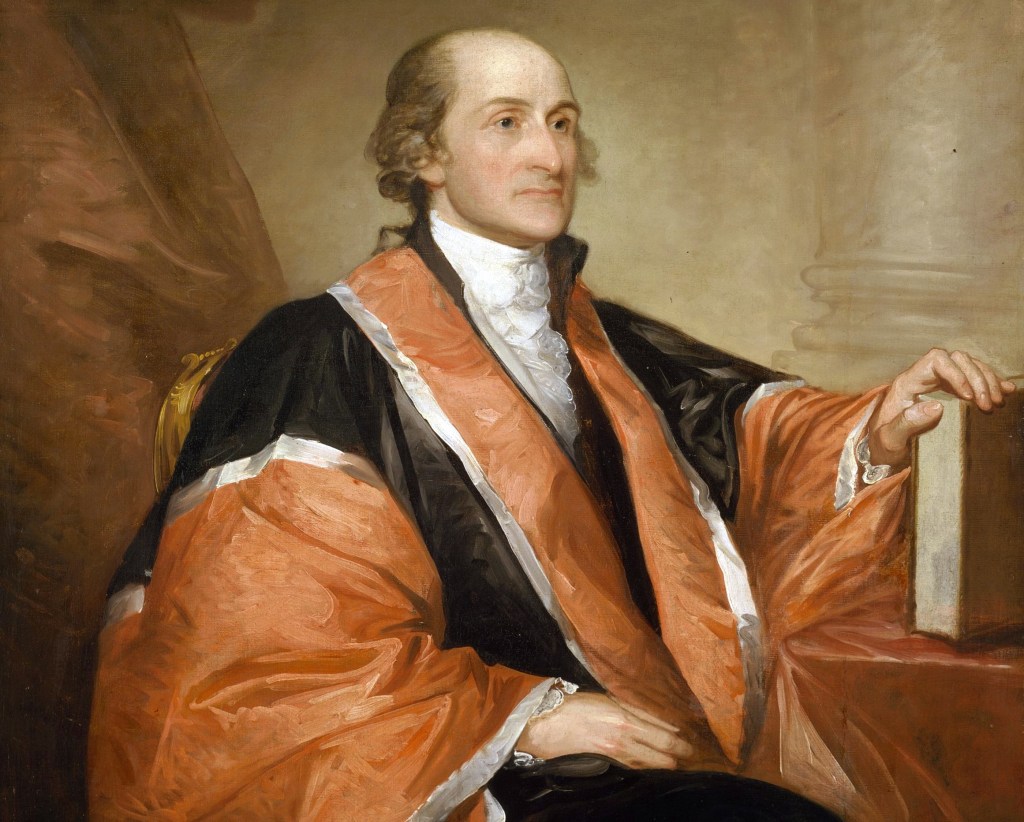
Now that the rules have been set, let’s take a look at an example that won’t be in the final rankings, John Jay.
John Jay assumed the role of the second (and final) Secretary of Foreign Affairs, which was the precursor to the State Department during the era of the Articles of Confederation. His tenure spanned from December 1784 to March 1789, with intermittent periods of leave interspersed throughout his service. Following the ratification of the new US Constitution, President Washington rebranded the office as the State Department, wherein Jay continued to serve as the Acting Secretary until the Senate’s confirmation of Thomas Jefferson. Overall, Jay fulfilled the role of Chief Diplomat for a duration of nearly five years.
From the outset, John Jay shouldered immense responsibilities, particularly in securing recognition and establishing a place for the young nation on the international stage. His prior experience as the Minister (Ambassador) to Spain during the Revolutionary War had equipped him with valuable expertise in these endeavors. Notably, Jay played a significant role in the negotiations that culminated in the 1783 Treaty of Paris, which brought an end to the Revolutionary War. Upon his return to the United States in 1784, he received the news of his appointment as the Secretary of Foreign Affairs.
During his tenure in Foreign Affairs, John Jay assumed the arduous task of navigating the frigid tensions between the newly-formed United States and their former sovereign, Great Britain. These tensions encompassed various contentious issues, such as the British occupation of forts they had previously agreed to evacuate, the financing of militarization efforts and aggression by American Indians against the United States, as well as the confiscation of American ships, commodities, and sailors. Regrettably, Jay departed from office before substantial progress could be made on this front.
Subsequent to his service as Secretary of Foreign Affairs, John Jay accepted President Washington’s nomination to become the inaugural Chief Justice of the nation. Nonetheless, Jay’s involvement in diplomatic affairs endured. When internal divisions within Washington’s cabinet hindered a unified response to Great Britain, John Jay was dispatched to engage in negotiations with the British.
Jay attempted to use US neutrality as leverage, threatening the British that the US and other neutral nations such as Denmark and Sweden would defend such neutrality by force using arms, if necessary. However, the cabinet squabbles led to Great Britain learning that the US was not ready to make good on these threats, and John Jay lost much of his bargaining power. This hastened negotiations and led to the Jay Treaty, where Britain agreed to vacate the forts it already agreed to vacate and provide the US with “most favored nation” status in trade, but at the cost of US trade to the British West Indies and the acceptance of Britain seizing American goods bound for France if they were compensated.
Unfortunately, not much else is notable of John Jay’s tenure as Chief Diplomat. Overall, Jay was fairly effective in preventing a rise in tensions between the US and Great Britain. However, these tensions would lead to war with Britain in 1812, and even a “Quasi-War” with the French in 1798 marking a key failure of Jay to secure long-term peace for the burgeoning nation. Jay did not create any notable procedures or traditions but did oversee half-a-dozen nations recognizing US independence.
Overall, I assign John Jay a grade of B-
1

1


 Kian Williams
Leave a comment